
The small esb board
#esbReno
#esbReno, the small esb board, specifically designed for attic renovations.
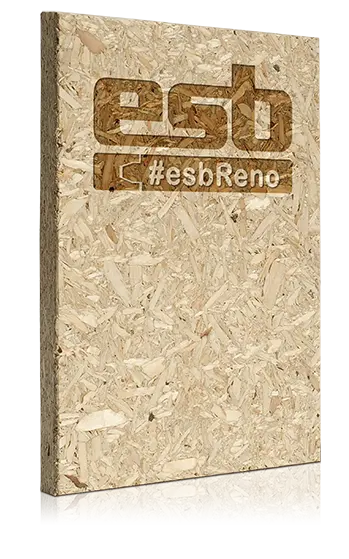
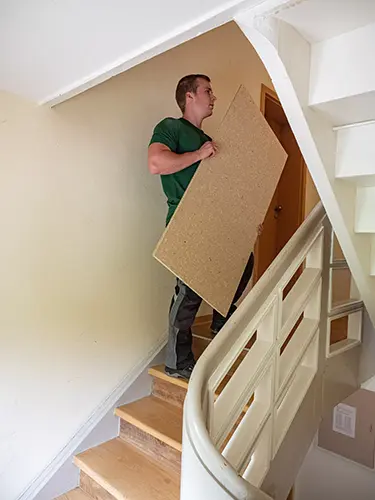
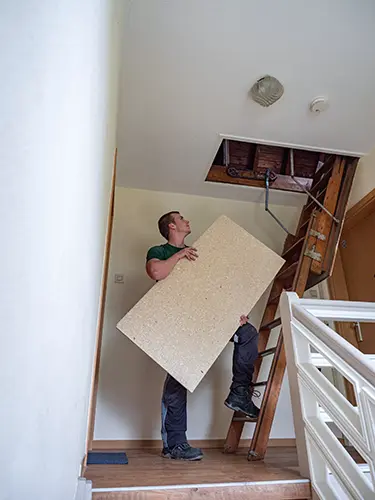
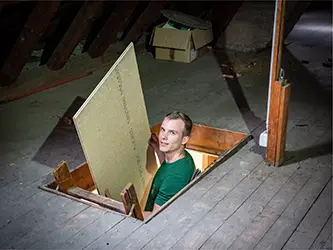
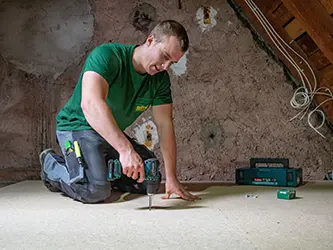
Our new #esbReno is perfectly suited for attic renovations due to its size. Narrow staircases and small roof hatches are no longer a problem.
A well-insulated attic brings significant energy savings. Effective insulation reduces heat loss, leading to less reliance on heating and air conditioning. In addition to proper insulation, the choice of material for the ceiling cladding is crucial. Due to the specific climatic conditions in the unheated attic space, we recommend using largely diffusion-open esb boards.
These boards allow for moisture-regulating exchange of water vapor between the interior space and the insulation. This prevents moisture from being trapped in the insulation, which could potentially lead to mold formation or other moisture-related issues.
Using esb as the ceiling board in an insulated attic is a sensible measure to achieve long-term energy savings and protect your valuable building structure.
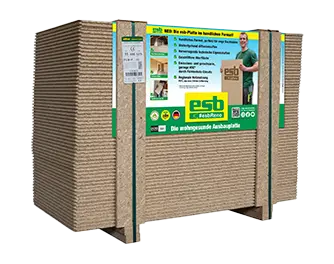
| #esbReno – Formats and designsP5 E1E05, four-sided N+F | ||
|---|---|---|
| Cover format = 1275 x 495 mm | ||
| Strength | Package contents | Panel weight |
| 15mm | 60 pieces | 6 kg |
| 22mm | 40 pieces | 9 kg |
esb panels are also available in larger formats and other thicknesses: esb standard
Example application: Interior ceiling towards unheated space
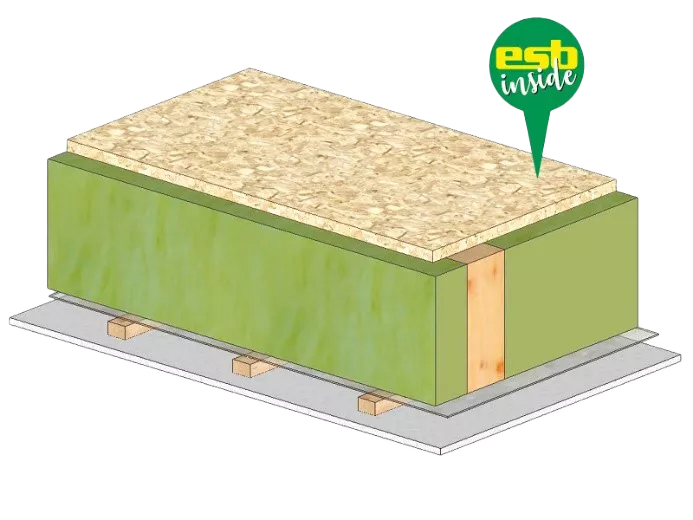
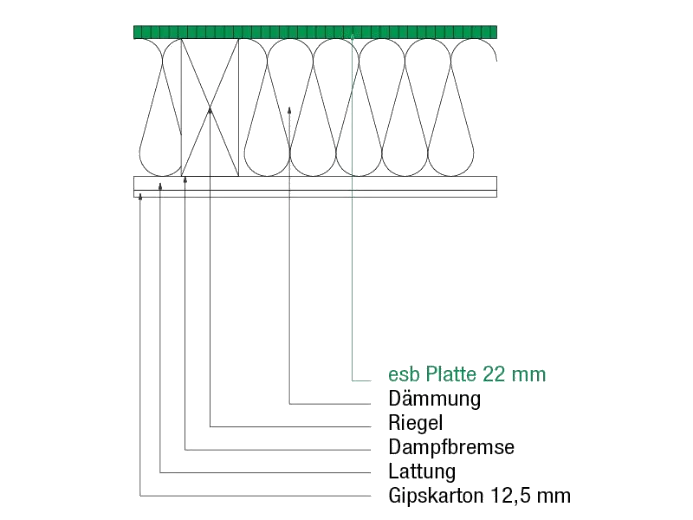
In this example, #esbReno can be used as an internal ceiling board to separate the heated living space from the unheated attic or loft area. The #esbReno boards provide insulation and help regulate moisture exchange, ensuring a comfortable and energy-efficient environment. The tongue and groove design of the boards allows for easy installation and a seamless finish. With #esbReno, you can create a well-insulated barrier that enhances energy savings and protects your home’s structure in the unheated space.
For a construction without a vapor barrier, it is recommended to conduct a building physics assessment of the chosen assembly.
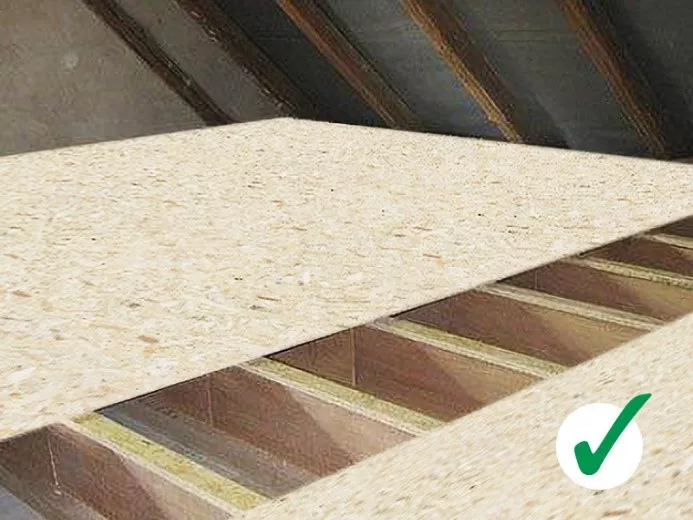
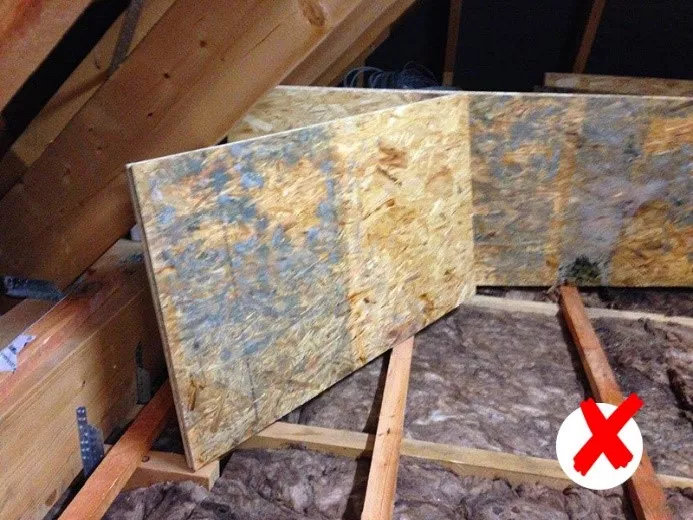
What makes the esb panels from elka so unique?
- Spruce wood sourced from the region
- Minimum density of 620 kg/m³
- Bending strength and equal modulus of elasticity in both directions for optimal board utilization
- Largely diffusion-open – suitable for open and closed construction methods
- Easy to work with; bonded without isocyanates (MDI)
- Low splintering during processing and smooth surface
- High screw and nail withdrawal strength





Product data
#esbReno- 15 mm
Damp / wet room
Suitable for damp rooms
Surface
ground
Material
Wood-based material
Chipboard
Emission class
E1E05
Width (mm)
495
Length (mm)
1275
Fire behavior
D-S2, dO
Formaldehyde emission according to EN 717-2
E1
Wood species
Spruce
Edge finish
Tongue and groove
Flexural strength (N/mm²)
16
Thermal conductivity (W/(m*K))
0,12
Paintable
Yes
24h swelling (%)
< 10
Can be used as a soffit panel
Yes
Waste wood free
Yes
Durability (thickness swelling) (%)
10
Durability (moisture resistance) (N/mm²)
0.14
Formaldehyde chlorate
≤ 0.05 ppm (E1E05)
IPPC standard
ISPM No. 15 for wooden packaging
Standard Fire behavior
EN 13501-1
Transverse tensile strength (N/mm²)
0.45
Sound absorption coefficient
0.10 / 0.25
Technological advantages
Bending strength and E-module the same in both directions, higher transverse tensile strength than OSB (approx. 40% higher), lower swelling than OSB, can be used as N+F underlay board in accordance with ZVDH/Cologne
Water vapor permeability μ
Dry / wet = 80/40
Further properties
Almost closed surface, fresh wood without odor emission, application of adhesives, paints and varnishes possible, high fitting accuracy
#esbReno- 22 mm
Damp / wet room
Suitable for damp rooms
Surface
ground
Material
Wood-based material
Chipboard
Emission class
E1E05
Width (mm)
495
Length (mm)
1275
Fire behavior
D-S2, dO
Formaldehyde emission according to EN 717-2
E1
Wood species
Spruce
Edge finish
Tongue and groove
Flexural strength (N/mm²)
14
Thermal conductivity (W/(m*K))
0,12
Paintable
Yes
24h swelling (%)
< 10
Can be used as a soffit panel
Yes
Waste wood free
Yes
Durability (thickness swelling) (%)
10
Durability (moisture resistance) (N/mm²)
0.12
Formaldehyde chlorate
≤ 0.05 ppm (E1E05)
IPPC standard
ISPM No. 15 for wooden packaging
Standard Fire behavior
EN 13501-1
Transverse tensile strength (N/mm²)
0.40
Sound absorption coefficient
0.10 / 0.25
Technological advantages
Bending strength and E-module the same in both directions, higher transverse tensile strength than OSB (approx. 40% higher), lower swelling than OSB, can be used as N+F underlay board in accordance with ZVDH/Cologne
Water vapor permeability μ
Dry / wet = 80/40
Further properties
Almost closed surface, fresh wood without odor emission, application of adhesives, paints and varnishes possible, high fitting accuracy
Do you have questions about our esb range?
Our customer advisor will be happy to help you by telephone at
+49(0)6533 / 956 332
Or send your request by e-mail to
[email protected]